Love this? Save it for later!
Share the inspiration with your friends
Introduction
This was supposed to be butternut squash soup. I had the recipe memorized, the big squash was sitting on my counter, and I was ready for my annual fall soup ritual. But the grocery store had other plans. They were out of butternut squash entirely. I stood there in the produce aisle, honestly a little annoyed, staring at these tiny, wrinkled-looking squash I’d never really noticed before. Honeynut squash. They looked like someone had shrunk a butternut in the wash.
I grabbed three of them out of pure stubbornness. I mean, I was already at the store, I had a soup craving, and I wasn’t about to go home empty-handed. The cashier even asked if those were “baby pumpkins.” I just nodded. Back in my kitchen, I roasted them not knowing what to expect. The smell that filled my apartment was ridiculous—way sweeter and more concentrated than butternut. I scraped the flesh out, blended it with some broth and a little coconut milk, and took a taste. Honestly, I just stood there holding the spoon, not believing what I was tasting. It was richer, creamier, and somehow more comforting than any squash soup I’d ever made on purpose.
That accidental swap turned into my most-requested fall recipe. Maybe you’ve been there—staring at an unfamiliar ingredient, wondering if you should just try something else entirely. Let me tell you, sometimes the wrong ingredient is actually the right one. This honeynut squash soup with toasted walnuts has that rare ability to make everything feel okay again, even on the grayest November afternoon. It’s the kind of soup you make when you need a hug in a bowl, and honestly, it came from a moment of pure kitchen stubbornness.
Why You’ll Love This Recipe
I have tested this recipe at least seven times across three different ovens, and I can tell you with total confidence—this is the one. The honeynut squash brings a natural sweetness that butternut just can’t match, and the toasted walnuts add that perfect little crunch that makes every spoonful interesting. Here is why this soup deserves a permanent spot in your rotation:
- Quick & Easy : From cutting board to bowl in under 45 minutes. The squash roasts while you toast the walnuts and sauté the aromatics. No babysitting required.
- Simple Ingredients : You probably have onions, garlic, and broth in your kitchen right now. The honeynut squash is the only special item, and it’s showing up at more grocery stores every fall.
- Perfect for Cozy Nights : This soup was born for cold weather, rough days, and evenings when you just want to curl up on the couch with something warm.
- Crowd-Pleaser : I brought this to a friend’s soup swap last year, and three people asked for the recipe before I even left. Kids love it too—the sweetness hooks them immediately.
- Unbelievably Delicious : The texture is velvety without being heavy, and the flavor has this deep, almost caramelized quality that feels way more complex than the ingredient list suggests.
What makes this recipe different from the dozens of squash soups out there is the roasting technique. I roast the honeynut squash cut-side down until the edges are deeply caramelized, which concentrates the natural sugars and gives the soup a richer, more developed flavor. No boiling, no steaming—just pure oven magic. This is comfort food that actually delivers on its promise. It soothes without weighing you down, and it tastes like something you’d order at a cozy café, not something you threw together on a Tuesday night.
What Ingredients You Will Need
This recipe relies on a short list of simple ingredients, each one pulling its weight. The honeynut squash does most of the heavy lifting, but the supporting players matter too. Here is everything you need:
- Honeynut squash (3 medium, about 1.5 pounds total) — Look for squash that feels heavy for its size with no soft spots. The skin should be a deep tan-orange color. You do not need to peel them before roasting—the skin softens enough to blend right in.
- Yellow onion (1 large, roughly chopped) — Adds savory depth that balances the sweetness of the squash. Sweet onions work too if that is what you have.
- Garlic cloves (4 cloves, smashed) — I leave them whole and smash them lightly with the side of my knife. They roast alongside the onion and get sweet and mellow.
- Vegetable broth (4 cups, low-sodium) — Use a good-quality broth here since it is the liquid base. I prefer homemade vegetable broth when I have it, but store-bought works fine. Just watch the salt level.
- Coconut milk (1/2 cup, full-fat) — This adds creaminess without dairy. The coconut flavor is subtle—it just makes the soup feel luxurious. Heavy cream works if you are not dairy-free.
- Walnuts (1/2 cup, roughly chopped) — Toast these in a dry skillet until fragrant. They add crunch and a slightly bitter note that cuts through the sweetness beautifully.
- Olive oil (2 tablespoons, plus more for drizzling) — Use a good extra-virgin olive oil for roasting the squash and sautéing the aromatics.
- Maple syrup (1 tablespoon) — Just a touch to enhance the natural sweetness of the squash. Leave it out if your squash is already very sweet.
- Fresh thyme (4 sprigs) — Adds an earthy, slightly floral note. Dried thyme works in a pinch—use 1 teaspoon.
- Salt and black pepper (to taste) — I use fine sea salt and freshly cracked black pepper. Start with 1 teaspoon salt and adjust from there.
- Optional garnish — A drizzle of olive oil or coconut cream, a few extra toasted walnuts, and a sprinkle of flaky sea salt right before serving.
I recommend using Pacific Foods vegetable broth if you are buying store-bought—it has a clean flavor that doesn’t overpower the squash. For the coconut milk, Thai Kitchen full-fat is my go-to because it is thick and creamy without any weird additives. If you cannot find honeynut squash, butternut squash is a fine substitute, just know the soup will be slightly less sweet and you may need to roast it a little longer.
Equipment Needed

You do not need a fancy kitchen to make this soup. Here is what you will need:
- Baking sheet (half-sheet size, rimmed) — For roasting the squash. Line it with parchment paper for easier cleanup.
- Chef’s knife — A sharp knife makes cutting the squash much safer. Honeynut squash is smaller and easier to cut than butternut, but it is still dense.
- Cutting board — Use a sturdy board that won’t slip. Place a damp paper towel underneath to keep it steady.
- Large pot or Dutch oven (5-6 quart) — For sautéing the aromatics and simmering the soup. A heavy-bottomed pot works best for even heat.
- Immersion blender — This is my preferred tool for blending hot soup directly in the pot. It saves you from transferring hot liquid to a blender, which is always a little risky. I use a Cuisinart immersion blender and it has held up for years.
- Regular blender — If you do not have an immersion blender, a countertop blender works too. Just blend in batches and remove the center cap from the lid to let steam escape. Cover the lid with a kitchen towel.
- Small skillet — For toasting the walnuts. A dry skillet over medium heat works perfectly.
- Measuring cups and spoons — For accuracy, especially with the broth and coconut milk.
- Wooden spoon or spatula — For stirring the aromatics and scraping up any browned bits from the bottom of the pot.
If you are on a budget, skip the immersion blender and use a regular blender. Just be careful with the hot liquid—let it cool slightly before blending, and never fill the blender more than halfway. A potato masher can work in a pinch if you want a chunkier texture, but the soup really shines when it is silky smooth.
Preparation Method
Let me walk you through this step by step. The process is straightforward, but a few small details make a big difference in the final result.
- Preheat your oven to 400°F (200°C). Position the rack in the middle of the oven. While it heats up, line a baking sheet with parchment paper for easy cleanup.
- Prepare the honeynut squash. Using a sharp chef’s knife, carefully cut each squash in half lengthwise. Scoop out the seeds and stringy pulp with a spoon. You can save the seeds and roast them separately if you like—they make a great snack. Place the squash halves cut-side down on the prepared baking sheet. Drizzle with olive oil and rub it all over the skin. Roast for 30-35 minutes, until the flesh is fork-tender and the cut sides are deeply caramelized. The skin will look slightly wrinkled and the edges will be brown. Let them cool for 5 minutes.
- Toast the walnuts. While the squash roasts, place the chopped walnuts in a small dry skillet over medium heat. Shake the pan occasionally and toast for 3-4 minutes until they are fragrant and slightly darker in color. Watch them carefully—walnuts burn fast. Transfer to a small bowl and set aside.
- Sauté the aromatics. In a large pot or Dutch oven, heat 2 tablespoons of olive oil over medium heat. Add the chopped onion and cook for 5-6 minutes, stirring occasionally, until softened and translucent. Add the smashed garlic cloves and cook for another minute until fragrant. Do not let the garlic brown—it will turn bitter.
- Add the broth and thyme. Pour in 4 cups of vegetable broth and add the fresh thyme sprigs. Bring the mixture to a gentle simmer over medium-high heat, then reduce the heat to low. Let it simmer while you finish the squash.
- Scoop the roasted squash. Once the squash halves are cool enough to handle, use a spoon to scoop the flesh away from the skin. The flesh should come off easily in large pieces. Discard the skins. Add all the squash flesh to the pot with the broth and aromatics.
- Simmer everything together. Stir in the maple syrup and 1 teaspoon of salt. Bring the soup back to a gentle simmer and cook for 5 minutes, allowing the flavors to meld. Remove the thyme sprigs and discard them.
- Blend until smooth. If using an immersion blender, blend the soup directly in the pot until completely smooth. If using a countertop blender, work in batches. Fill the blender no more than halfway, remove the center cap from the lid, and cover the opening with a kitchen towel to allow steam to escape. Blend each batch until velvety smooth, then pour into a clean pot or bowl.
- Stir in the coconut milk. Once the soup is blended, stir in the coconut milk until fully incorporated. Taste and adjust the seasoning with more salt and pepper as needed. If the soup is too thick, add a splash more broth or water until it reaches your desired consistency.
- Serve and garnish. Ladle the soup into bowls. Top each serving with a generous sprinkle of toasted walnuts, a drizzle of olive oil or coconut cream, and a pinch of flaky sea salt. A few fresh thyme leaves on top look beautiful too.
Cooking Tips & Techniques
I have made this soup more times than I can count, and I have definitely made my share of mistakes along the way. Here are the things I wish someone had told me earlier:
Roast the squash cut-side down. This is non-negotiable. When the cut side faces down on the hot baking sheet, it caramelizes directly against the surface. That browning is where the deep, sweet flavor comes from. If you roast it cut-side up, the flesh just steams and you lose all that complexity. I learned this the hard way after making a flat, boring soup my first time.
Do not skip toasting the walnuts. Raw walnuts are fine in a pinch, but toasting transforms them completely. The heat brings out their natural oils and adds a nutty, almost buttery flavor. It takes three minutes and makes a huge difference. Just keep an eye on them—I have burned more batches than I care to admit because I walked away to check the squash.
Season in layers. Add salt at the beginning when you sauté the onions, again when you add the broth, and again at the end after blending. Each layer of salt builds depth. If you wait until the end, the soup will taste flat no matter how much salt you add.
Let the soup cool slightly before blending. Hot liquid expands in a blender, and the steam can blow the lid off. I know this because it happened to me, and cleaning squash soup off my ceiling was not fun. Let the soup sit for 5-10 minutes after simmering, or blend in small batches with the lid vented.
Adjust the consistency to your preference. Some people like their squash soup thick enough to coat a spoon, others prefer it more brothy. The beauty of this recipe is that you control the final texture. Add more broth or water a little at a time until it looks right to you.
Make it ahead of time. This soup actually tastes better the next day. The flavors have time to settle and meld together. I often make it a day ahead and reheat it gently on the stove. Just stir in the coconut milk after reheating to keep it from separating.
Variations & Adaptations
One of the best things about this soup is how flexible it is. Here are some ways to make it your own:
Dairy-Free and Vegan — This recipe is already dairy-free and vegan as written, thanks to the coconut milk. If you want to avoid coconut, use cashew cream instead. Soak 1/2 cup raw cashews in hot water for 15 minutes, then blend with 1/2 cup water until smooth. Stir it in at the end just like you would the coconut milk.
Add Some Heat — I love adding a pinch of red pepper flakes or a small diced jalapeño when I sauté the onions. The heat cuts through the sweetness and adds a nice little kick. Start with a small amount and taste as you go.
Roasted Carrot and Squash Combo — Swap one of the honeynut squash for two large carrots, peeled and chopped into chunks. Roast the carrots alongside the squash. The carrots add even more sweetness and a beautiful orange color. This is my favorite variation when I want the soup to feel extra hearty.
Herb Swap — If you do not have fresh thyme, try fresh rosemary or sage instead. Rosemary adds a piney, aromatic quality, while sage brings an earthy, almost floral note. Use 2 sprigs of rosemary or 4 fresh sage leaves. Remove them before blending just like the thyme.
Spiced Version — Add 1 teaspoon of ground cumin and 1/2 teaspoon of smoked paprika when you sauté the onions. The cumin adds warmth and the smoked paprika gives the soup a subtle smoky depth. This version pairs beautifully with a dollop of Greek yogurt on top.
Make It a Meal — Stir in 1 cup of cooked white beans or chickpeas after blending for added protein and fiber. The beans blend in completely and make the soup even creamier without changing the flavor much. I do this when I want the soup to be a full dinner.
Serving & Storage Suggestions
This soup is at its best served hot, straight from the pot, with all the toppings. Here is how to make the most of it:
Serving Temperature — Serve the soup piping hot, but not boiling. Let it cool for a minute or two after ladling into bowls. The flavors are most pronounced when the soup is warm but not scorching.
Presentation — Pour the soup into shallow bowls for a more elegant look. Drizzle a little coconut cream or olive oil in a swirl on top, then sprinkle the toasted walnuts and a pinch of flaky sea salt. A few fresh thyme leaves or a small sage leaf on top adds a nice finishing touch.
What to Serve With It — This soup pairs beautifully with crusty bread or a simple green salad. I love serving it alongside a kale salad with lemon vinaigrette for a complete fall meal. A grilled cheese sandwich is also a classic pairing—the crispy bread and melted cheese are perfect for dipping.
Storing Leftovers — Let the soup cool completely before transferring to an airtight container. It will keep in the refrigerator for up to 5 days. The flavors actually deepen over time, so leftovers taste even better than the first serving.
Freezing Instructions — This soup freezes beautifully. Pour cooled soup into freezer-safe containers or zip-top bags, leaving about an inch of headroom for expansion. Freeze for up to 3 months. Thaw overnight in the refrigerator before reheating.
Reheating Tips — Reheat the soup gently on the stovetop over medium-low heat, stirring occasionally. If the soup has thickened after refrigeration, add a splash of broth or water to thin it out. You can also reheat individual portions in the microwave—just cover the bowl and heat in 30-second intervals, stirring between each. If the coconut milk has separated slightly, a quick stir will bring it back together.
Nutritional Information & Benefits
This soup is as nourishing as it is comforting. Here is a rough estimate per serving (based on 4 servings):
| Nutrient | Amount per Serving |
|---|---|
| Calories | 280 |
| Total Fat | 16g |
| Saturated Fat | 5g |
| Carbohydrates | 32g |
| Fiber | 6g |
| Sugar | 12g |
| Protein | 5g |
| Vitamin A | 280% DV |
| Vitamin C | 35% DV |
| Potassium | 15% DV |
Honeynut squash is packed with vitamin A in the form of beta-carotene, which supports eye health and immune function. Walnuts are a great source of omega-3 fatty acids, which are important for brain health. The coconut milk provides healthy medium-chain triglycerides (MCTs) that can help with energy and satiety. This soup is naturally gluten-free, dairy-free, and vegan, making it suitable for a wide range of dietary needs. The only potential allergen is tree nuts from the walnuts, which you can easily omit or swap for pumpkin seeds.
I love that this soup feels indulgent but is actually really good for you. It is the kind of meal that nourishes your body and your soul at the same time, which is exactly what comfort food should do.
Conclusion
This honeynut squash soup with toasted walnuts started as a complete accident, but it has become one of my most treasured recipes. It is proof that sometimes the best things come from mistakes, from grabbing the wrong squash or being too stubborn to leave the store empty-handed. Every time I make it, I am reminded that cooking is not about perfection—it is about showing up, trying something, and being open to happy surprises.
I hope you give this soup a chance, whether you find honeynut squash at your local market or decide to try it with butternut instead. Customize it however you like—add more spice, swap the nuts, make it your own. That is the beauty of a recipe like this. It is a starting point, not a rulebook.
If you make this soup, I would love to hear about it. Drop a comment below and tell me how it turned out, what variations you tried, or just share your own kitchen accident story. And if you loved it, please share this recipe with someone who needs a little warmth in their life. Until next time, happy cooking!
Frequently Asked Questions
Can I use butternut squash instead of honeynut?
Absolutely. Butternut squash is the closest substitute and works perfectly. The soup will be slightly less sweet, so you may want to add an extra teaspoon of maple syrup. Roast the butternut squash for 35-40 minutes instead of 30, since butternut pieces are typically larger.
Do I have to peel the honeynut squash before roasting?
Nope. The skin of honeynut squash is thin enough that it softens completely during roasting and blends right into the soup. Just wash the squash well before cutting. If you are using butternut squash, you should peel it first since the skin is thicker and tougher.
Can I make this soup without coconut milk?
Yes. You can substitute the coconut milk with heavy cream, half-and-half, or cashew cream. For a lighter option, use an extra 1/2 cup of vegetable broth. The soup will be less creamy but still delicious.
How do I store and reheat leftovers?
Store leftovers in an airtight container in the refrigerator for up to 5 days. Reheat gently on the stovetop over medium-low heat, adding a splash of broth if needed. You can also freeze the soup for up to 3 months. Thaw overnight in the fridge before reheating.
Can I make this soup in advance for a party?
Yes, and I actually recommend it. This soup tastes even better the next day because the flavors have time to meld. Make it a day ahead, let it cool, and store it in the refrigerator. Reheat gently on the stovetop and stir in the coconut milk just before serving. Add the toasted walnuts and garnishes right before serving to keep them crunchy.
Pin This Recipe!
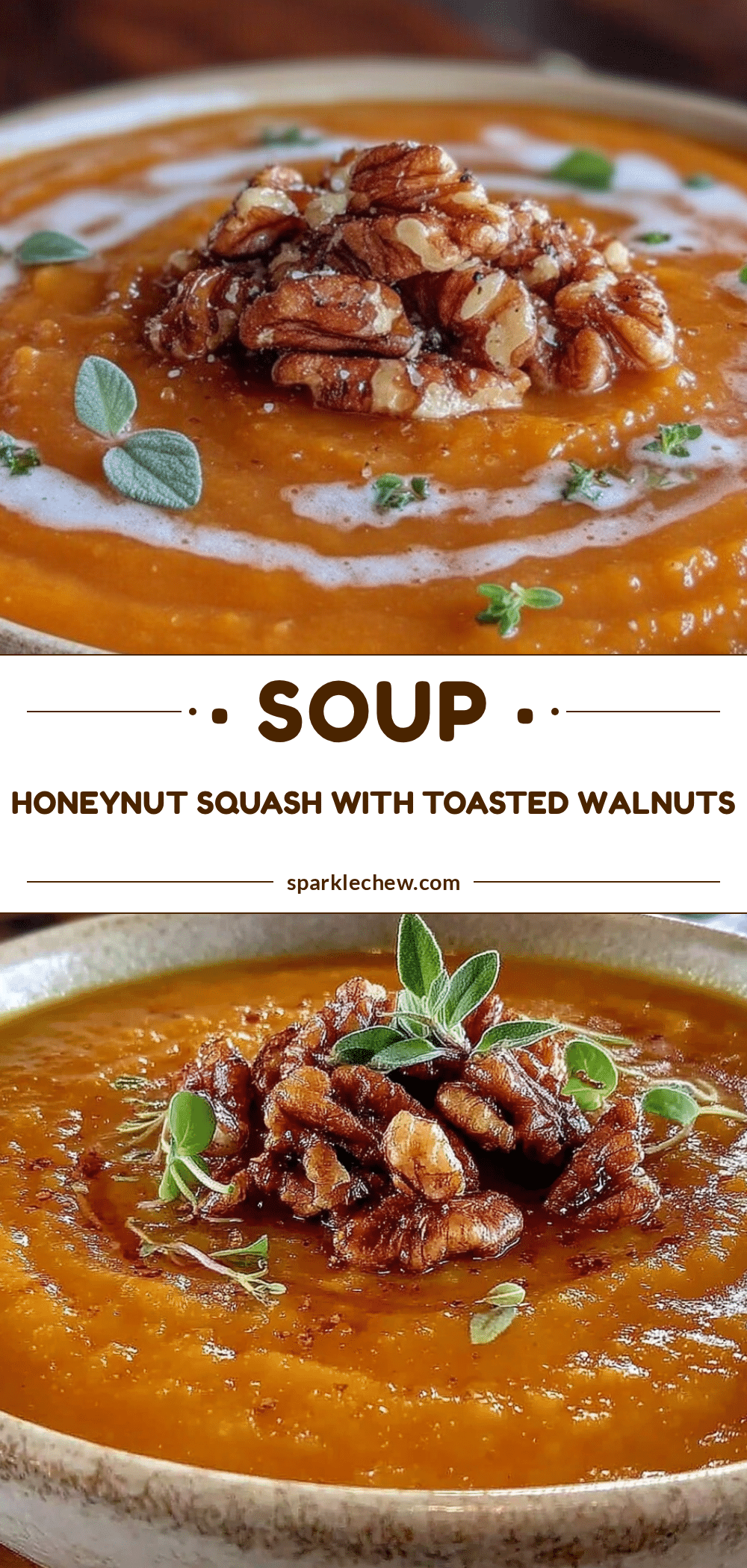
Best Honeynut Squash Soup with Toasted Walnuts – Easy & Cozy

This creamy, velvety honeynut squash soup with toasted walnuts is the ultimate comfort food for cold days. Roasted honeynut squash is blended with coconut milk and aromatic vegetables for a naturally sweet, deeply flavorful soup that comes together in under 45 minutes.
- Prep Time: 15 minutes
- Cook Time: 30 minutes
- Total Time: 45 minutes
- Yield: 4 servings 1x
- Category: Soup
- Cuisine: American
Ingredients
- 3 medium honeynut squash (about 1.5 pounds total)
- 1 large yellow onion, roughly chopped
- 4 garlic cloves, smashed
- 4 cups low-sodium vegetable broth
- 1/2 cup full-fat coconut milk
- 1/2 cup walnuts, roughly chopped
- 2 tablespoons olive oil, plus more for drizzling
- 1 tablespoon maple syrup
- 4 sprigs fresh thyme
- 1 teaspoon fine sea salt, plus more to taste
- Freshly cracked black pepper to taste
- Optional garnish: olive oil or coconut cream, extra toasted walnuts, flaky sea salt
Instructions
- Preheat your oven to 400°F (200°C). Line a baking sheet with parchment paper.
- Cut each honeynut squash in half lengthwise. Scoop out seeds and stringy pulp. Place squash halves cut-side down on the prepared baking sheet. Drizzle with olive oil and rub over the skin. Roast for 30-35 minutes until fork-tender and caramelized. Let cool for 5 minutes.
- While squash roasts, toast walnuts in a dry skillet over medium heat for 3-4 minutes until fragrant. Transfer to a bowl and set aside.
- In a large pot or Dutch oven, heat 2 tablespoons olive oil over medium heat. Add chopped onion and cook for 5-6 minutes until softened. Add smashed garlic and cook 1 minute more until fragrant.
- Pour in vegetable broth and add fresh thyme sprigs. Bring to a gentle simmer, then reduce heat to low.
- Scoop roasted squash flesh from skins and add to the pot. Discard skins.
- Stir in maple syrup and 1 teaspoon salt. Simmer for 5 minutes. Remove thyme sprigs and discard.
- Blend soup until smooth using an immersion blender or countertop blender (in batches, venting the lid).
- Stir in coconut milk until fully incorporated. Adjust seasoning with salt and pepper. Add more broth or water if needed to reach desired consistency.
- Ladle into bowls. Top with toasted walnuts, a drizzle of olive oil or coconut cream, and a pinch of flaky sea salt.
Notes
Roast squash cut-side down for best caramelization. Do not skip toasting walnuts. Season in layers for depth. Let soup cool slightly before blending to avoid steam explosions. Soup tastes even better the next day. For a dairy-free/vegan option, use coconut milk as written. To make ahead, prepare without coconut milk, then stir in after reheating.
Nutrition
- Serving Size: 1 serving (about 1.5
- Calories: 280
- Sugar: 12
- Sodium: 480
- Fat: 16
- Saturated Fat: 5
- Carbohydrates: 32
- Fiber: 6
- Protein: 5
Keywords: honeynut squash soup, roasted squash soup, vegan soup, gluten-free soup, fall soup, easy soup recipe, creamy squash soup, coconut milk soup, toasted walnuts